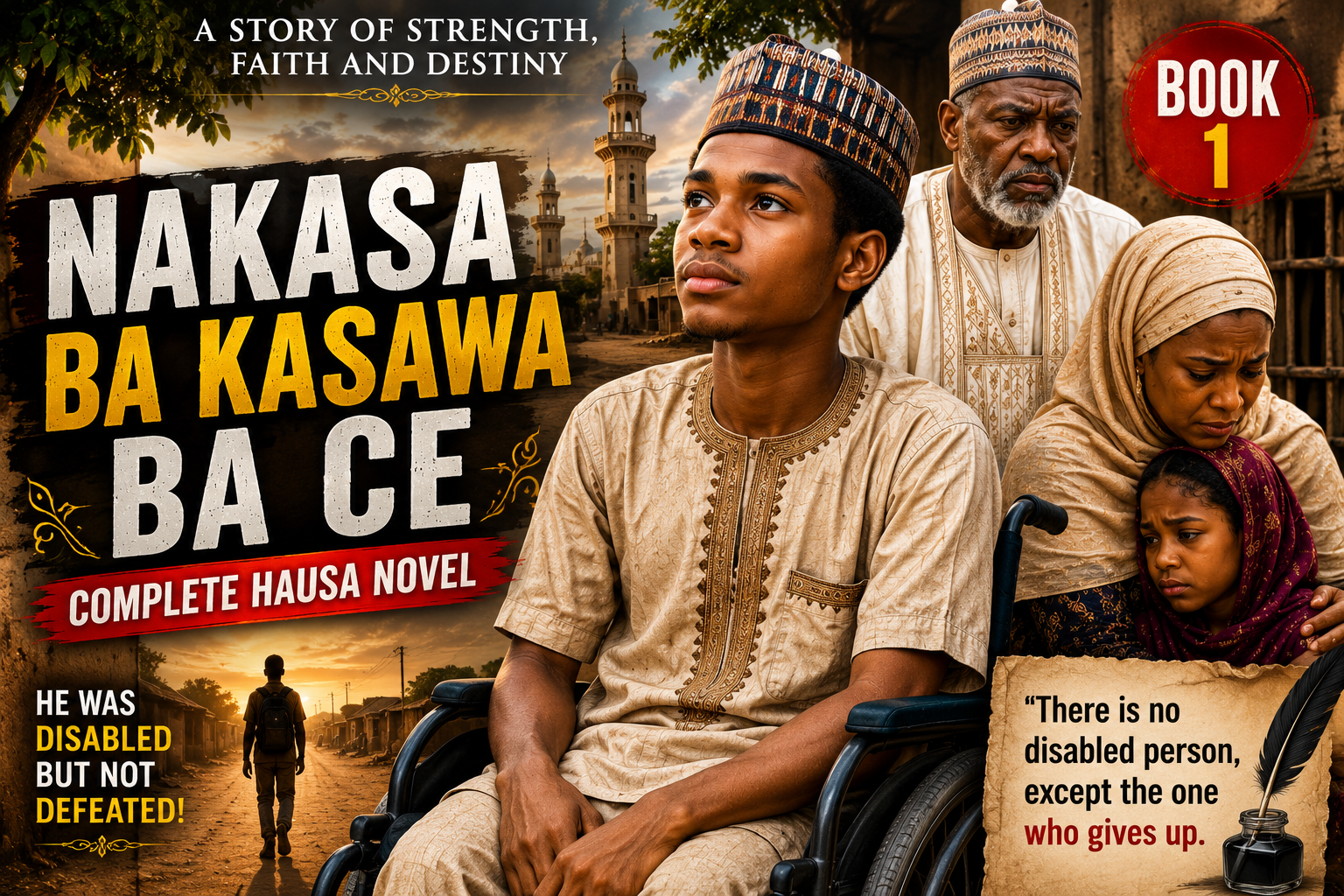
Nakasa Ba Kasawa Ba Ce Book 1 Complete Hausa Novel
Nakasa Ba Kasawa Ba Ce Book 1 Complete Hausa Novel is an inspiring Hausa story about strength, faith, disability, patience, family history, and the power of determination. The story begins with Saifuddeen Muhammad Ahmadu, a young man whose disability never became failure, because his life proves that weakness is not in the body but in giving up.
In The Name Of Allah
In the name of Allah, the Most Gracious, the Most Merciful.
All praise belongs to Allah, my Creator, who gave me life, health, calmness, and peace of mind. He increased my understanding, opened my thoughts, and brightened my insight until I found the opportunity to begin this new book of mine titled Nakasa Ba Kasawa Ba Ce.
O Allah, I hold firmly to You. Protect my pen from writing evil or anything that may become poison or trial for Your servants. O Lord of Majesty, purify my thoughts and hold my hand back from writing anything that may later become regret for me, no matter how small it may be.
O Allah, give me life and health to complete this book safely, both for me and for all the readers.
Dedication
This first page is yours, my younger sister and respected namesake, Fatima Sardauna. I rejoice with you over the successful completion of your book, Sooraj. May Allah increase your wisdom and intelligence. May Allah reward you for the lessons and guidance you share.
Nakasa Ba Kasawa Ba Ce
His disability did not become failure for him, because as the Hausa people say, there is no truly disabled person except the one who gives up.
He possessed a rare strength that even many healthy people without disability did not have. His life was a mirror for every person living with disability, and it was also an example for every healthy person. He was someone to admire, someone to love, and someone every believer with faith in the heart could desire to be like.
Just as his name was beautiful, so were his outward and inward qualities.
Saifuddeen Muhammad Ahmadu was a righteous and noble person. He was full of wisdom, intelligence, trust in Allah, and patience. He was handsome in a gentle and dignified way, with a natural aura of honor around him.
The Origin Of Saifuddeen’s Family
The roots and origin of Saifuddeen’s family came from the Fulani people of Dukku in Gombe State.
Dukku is one of the areas in Gombe. It is known as a land of Fulani people blessed with beauty, dignity, and a strong passion for seeking knowledge in both areas: Islamic education and Western education.
The people of Dukku became well known for excellence in many fields. Because of that, wherever they were found among people, they were respected as people of honor, value, dignity, and complete character.
Dukku, the land of sweet milk.
Malam Ahmadu
Malam Ahmadu was the grandfather of Saifuddeen and his siblings.
Malam Ahmadu was a full-blooded Fulani man from Dukku, from both his father’s and mother’s side. That was his root, the land of his parents and ancestors.
He was a great scholar, and in his time, there was no one like him in the whole of Dukku. Most of the children in the town studied under him because he had a large school. However, he did not keep almajiri students permanently. Whoever came would study, and when lessons ended, each child would return home.
Because of this, even children from distant neighborhoods came to learn from him. Some came from Sirinkiyo, Katafila, Fada, Dugge, and even from Shabewa. This made him famous throughout Dukku.
Even the Dukku Emirate respected him because he was the imam of the palace mosque.
Allah blessed him with properties and lands within Dukku town, as well as many farms. Most of those farms were inherited from his father, because they were the people who cleared the forests and hills around Dukku in the old days.
At that time, farmland was not usually bought. A person would enter the bush, clear a piece of land, prepare it, and that land would become his. The struggle and labor of clearing it made it his property.
Malam Ahmadu’s Family
Malam Ahmadu had one wife named Bintu. Allah blessed them with three children.
Their first son was named Muhammad Bello, who later became the father of Saifuddeen. After him came Aliyu, and then their youngest daughter, Aisha, whom they called Dada.
The children grew up with unity, mercy, and care for one another. There was no disrespect among them. Instead, there was honor, compassion, and love.
Malam Ahmadu arranged marriages for his sons.
Bello, the father of Saifuddeen, was a man of dignity and good manners. He was calm and gentle. That was why he was married to his cousin, a girl named Fatima, though she was called Bisije. Her children, including Saifuddeen and his siblings, later called her Ummi.
Ummi’s mother was the younger sister of Malam Ahmadu. Ummi was an orphan because, in one day, she lost both of her parents in a fire that consumed them during the night. At that time, she had been taken for weaning to her grandparents’ house, and that was how she survived.
Not long after that, her grandparents also passed away. Her care then returned to the house of Malam Ahmadu, her maternal uncle.
Bello’s Illness
Bello lived with a mental illness that came upon him from time to time. Whenever it returned, he suffered greatly. Because of that, his parents chose to marry him to Bisije, his cousin, believing that since she was his relative, she would have patience to live with him.
After all the wedding preparations and requirements were completed, Bisije and Bello were married. The wedding was done peacefully, and everyone dispersed safely.
But on the night after the wedding, when Bello’s friends were preparing to take him to his house, which had been built inside the original family compound, they suddenly found him digging a deep hole.
He had gathered firewood, arranged sticks, and lit a fire. He said he wanted to fall into it.
His friends Ashiru and Hamisu rushed toward him and held him back. But he kept trying to free himself, telling them to leave him so he could fall into the fire. According to him, paradise was beneath the fire, and they should allow him to enter it.
This incident frightened his relatives and friends that night. Hamisu and Ashiru had to sleep in his house because if they left him alone, he might kill himself. His illness had returned.
His younger brother Aliyu and his sister Dada spent the night comforting the new bride, who kept crying.
That was the beginning of Ummi’s sorrow. From the very day her wedding guests dispersed, she entered the harshness of life. From that day onward, after every five months, Bello’s illness would return. Sometimes it even returned three times in one year.
But Alhamdulillahi, the illness did not make him beat people or fight. Instead, he would wake up in the middle of the night and begin wandering around Dukku town. Whenever he found a mosque, he would stop and pray two rak’ahs. Then he would continue walking while reciting the Qur’an loudly.
By morning, his voice would be gone, and his feet would be swollen.
His father, Malam Ahmadu, and all his relatives searched for treatment for him, but Allah did not decree success through the treatments they found.
Ummi’s Patience
Years passed, and Ummi continued to endure life with her cousin and husband.
At one point, her uncle tried to separate the marriage, but she cried and refused. She said they should leave her with him. In her words, if she, his own relative, ran away from him, who would stay with him?
Because of that, Malam Ahmadu left them together while continuing to pray for his son’s recovery.
After many years, Allah blessed Bello and Ummi with six children: three boys and three girls.
Nuruddeen was the eldest. After him came Rahma, then Saifuddeen, then Raihana, then Raliyya, and finally the youngest, Hayatuddeen, who was Ummi and Bello’s last child.
Bello’s younger brother, Aliyu, had never had a child with his wife, not even a miscarriage. Nuruddeen and his siblings called him Bappa Ali.
Dada also got married, and the children called her Goggo Dada. Since giving birth to her first child, she had not given birth again. Her son’s name was Ahmad, and he was the same age as Saifuddeen.
The Death Of Malam Ahmadu And Bintu
While life continued, Allah took the life of Malam Ahmadu. He was the father they all called Abba.
From that day onward, the responsibility of caring for the students returned to Bappa Ali and to Bello whenever he was in his right state of mind.
Before Bintu could finish her waiting period after her husband’s death, Allah also took her life because of a severe stomach illness that lasted only one night.
From then on, Abba, Bappa Ali, and Goggo Dada held tightly to one another with trust, honesty, and compassion for their family.
The Children Grow Up
The children began growing older, but their father’s illness continued to affect their lives, especially Nuruddeen, Raihana, and Saifuddeen.
At that time, Saifuddeen was thirteen years old. He had already completed primary school and had continued to secondary school, where he was in JSS 1.
Nuruddeen had gone far in school and was already in SS3. Raihana was in SS2 because there was a slight age gap between them and Saifuddeen.
In Islamic education, the children had completed the recitation of the Holy Qur’an from a young age.
Saifuddeen had already completed the Qur’an the previous year, when he was twelve years old, just as his elder siblings had done. He had now focused his mind on memorization and other Islamic books taught in their Islamiyya school.
Saifuddeen Falls Sick
Saifuddeen was happy that he would soon move to JSS 2. But one day, suddenly, he woke up with a terrible fever that burned intensely.
He spent the night frightened and restless. By morning, he woke up with a runny nose. He had no cough, but his nose kept running. His nose became red, and his eyes also turned red.
When Ummi saw this, she held his hand and took him to show one of their elderly neighbors, Iya Shatu, the grandmother of Salisu, Saifuddeen’s friend.
As soon as the old woman saw Saifuddeen’s condition, she said it was a serious rash illness that was about to come out on his body, together with a severe fever that had covered him.
She asked for a small broom and millet. She crushed them, soaked them in water, took some into her mouth, and sprayed it over his body.
By the power of Allah, before nightfall, the rashes came out all over his body. They appeared everywhere, even under his feet. But the severe fever was still as if it wanted to kill him.
When night came, Ummi carried him back to her side of the house.
What happened felt like a dream. By the next morning, Saifuddeen’s body had changed. The rashes that had come out disappeared and went back inside his body. The child continued shaking because of the burning fever, and the severe illness gave him no peace. He could even hear a loud sound inside his ears like a heavy drumbeat.
They gave him many different medicines, but the rashes refused to come out again. At that time, people in the town did not take hospital treatment or vaccination seriously. Because of that, Saifuddeen suffered greatly from the illness and the fierce fever.
In the end, the sickness caused him to become deaf.
Saifuddeen Becomes Deaf
This incident shook their family deeply because Saifuddeen was a child who easily entered people’s hearts. He was calm, shy, and well behaved. His parents, siblings, and relatives all loved him greatly.
The day they realized Saifuddeen had become deaf, that day they saw a terrible shock in Bello, his father. Nuruddeen also cried endlessly when he returned from school and heard what had happened. Among all his younger siblings, he loved Saifuddeen the most.
Hayatuddeen was only four years old at that time, so he did not understand what was happening. He only cried whenever he saw the others crying.
That night, Bello’s illness returned. It was the first time he began screaming like a small child.
At exactly two in the morning, he held the hand of Saifuddeen, who was sleeping, and woke him up. Then he pulled him outside. He dragged him from place to place. Whenever they found a mosque, he made Saifuddeen perform ablution with him, and they prayed two rak’ahs of voluntary prayer. Then they continued walking.
They did not return home until after the dawn prayer, and even then, they only returned because Bello saw that Saifuddeen was crying.
The Pain Of Silence
When they returned home, Ummi pulled her son close and embraced him while crying. She kept asking him where they had gone.
Saifuddeen opened his mouth, intending to try speaking, but he could not.
That made him press his head against the wall and release a painful groan of helpless crying. Anyone with faith in the heart would have felt pity for him.
No one truly knew the pain and burning in his heart except someone who had experienced the same condition: to be born healthy and then suddenly be struck by disability in the middle of life.
He wanted to open his mouth and explain to his mother how he felt, but he could not. Allah had not given him the ability to do so at that moment.
When he pressed his head against the wall again and broke into another deep, painful sob, his elder brother stood and moved toward him.
Quickly, Nuruddeen held him.
He placed his hand under Saifuddeen’s head and supported him. With tears, pain, and pity for his younger brother, his voice trembled as he called:
“Saifuddeen…!”
That call carried all the fear, love, and helplessness in Nuruddeen’s heart. He could not bear seeing his beloved younger brother trapped in a condition he did not choose, unable to explain his pain, unable to answer his mother, and unable to understand why his world had suddenly changed.
From that moment, Saifuddeen’s journey became different. His disability had appeared, but his destiny had not ended. What looked like the beginning of weakness would later become the beginning of a powerful lesson for everyone around him.
Because truly, disability is not failure.
Book Details
- Author: Aisha Aliyu Garkuwa
- Status: Complete
- File: txt Nakasa_Ba_Kasawa_Bace_Part_1_Complete_Hausa_Novel
Book Links: Read Online | Download Book