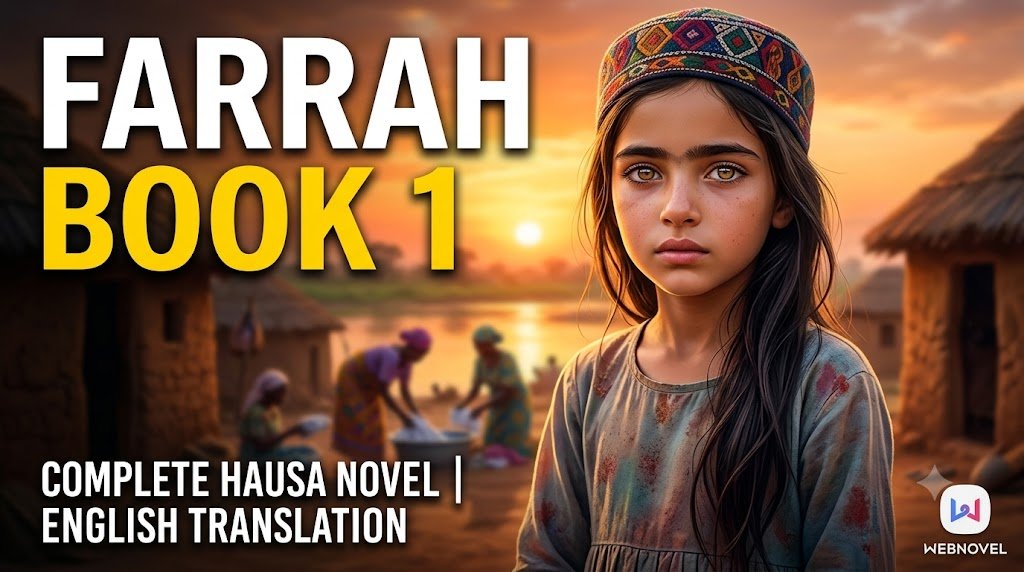
Farrah Hausa Novel Book 1 – Chapter 1 Narrative
The River Laundry Competition
A vast, powerful river flowed steadily through the countryside, its muddy, reddish water swirling with full force. Smooth, massive boulders and small pebbles lined the riverbanks, where over a hundred women and young girls had gathered. The area buzzed with loud chatter, singing, and laughter, turning the mundane task of washing clothes into a fierce village competition under the scorching afternoon sun.
Sitting quietly on a large rock was a young maiden named Farrah. A massive pile of freshly washed clothes sat before her, while an even larger stack waited at her side. Beads of sweat trickled down her cheeks, dripping into the flowing river.
Behind her stood two young girls, Rakiya and Atine, dressed in traditional wrappers with green silk headscarves. Chewing on sugarcane, they lazily watched the other women work.
“Wallahi, Rakiya, we are definitely winning this competition,” Atine boasted. “Look at Lami and Tani—they haven’t even finished half of their laundry!”
Rakiya spat out the sugarcane pulp, glared at Farrah’s back, and shouted, “Hey, Farrah! Can’t you move any faster? Tani and her group are going to beat us!”
Farrah didn’t utter a word; she simply accelerated her movements.
Frustrated, Rakiya scoffed and turned to Atine. “I swear, I feel like beating this girl up. I am going to make sure she is completely humiliated in this village.”
Atine sneered. “Humiliated? What’s left to humiliate? You’ve already rendered her deaf, and she’s practically turned into a domestic servant in your household.” She glared at Farrah and yelled, “Hey! You better hurry up, or you won’t get lunch or dinner today! You know how things work in that house!”
Farrah heard the harsh words, but she kept her head down and washed faster. She was exhausted. She hadn’t eaten a single bite since yesterday morning and had been working non-stop. Thanks to her energetic nature, she managed to finish the remaining heap of laundry within thirty minutes.
The moment Farrah finished, Rakiya shoved her hard from behind, sending her splashing headfirst into the deep river! Rakiya and Atine grabbed the clean laundry and began screaming with delight: “We finished first! We won!”
The local women watched in shock, but Rakiya and Atine paid no attention to the girl struggling in the water.
Farrah slowly pulled herself out of the river and wiped her wet face. As her eyes opened, they revealed striking white scleras and rare, light-brown pupils. Her thick, dark eyebrows almost met in the middle, and her fine hairline lay flat against her forehead from the dampness. She looked around quietly as Rakiya and her friends jumped for joy, celebrating their upcoming reward from the village chief (Mai Gari).
Farrah stepped onto dry land. She was slender and delicate, with a soft frame. Hearing laughter, she turned to see Rakiya’s friends pointing at her.
“Look at her! Her eyes look like a cat’s!” Ladidi mocked.
“She’s just a deaf dwarf!” Rakiya added.
Holding her head down, Farrah hurried away, walking back to their mud-brick compound in the village.
Starvation and the Kitchen Incident
The compound was completely empty when she arrived. Inna was at the Chief’s home, and the other children were still at the river. Farrah walked past the livestock pen and pushed open a small wooden door leading to her tiny room. The floor was bare dirt without even a plastic mat. The only items inside were a faded black mattress in the corner and a small bundle of clothes.
Weak with hunger, Farrah quickly changed out of her dripping garments into a faded long dress. Her long, dark hair cascaded down to her waist before she tucked it back under a dry cap.
After hanging her wet clothes on the line, she stood frozen in the yard, her stomach growling violently. Desperate for food, she walked toward the kitchen—a small area enclosed by corrugated zinc sheets.
Trembling from weakness, sheer survival instinct took over. She sprinted into the kitchen and uncovered a large pot of red palm-oil rice. Without caring about the intense heat, she plunged her hands directly into the pot and began eating ravenously.
Inna’s Cruelty & Malam’s Intervention
Suddenly, Inna’s voice echoed across the courtyard: “Salamu alaikum!”
Farrah’s heart sank. Panic-stricken, she backed away from the stove, her mouth and hands covered in red oil. Out of everyone in the world, Inna was the person she feared most. Hearing her voice alone sent shivers down Farrah’s spine.
In her panic, Farrah knocked over a stack of metal pots, sending them crashing to the floor.
Inna walked toward the kitchen and stopped dead in her tracks. She saw the pot lid on the floor and Farrah cowering behind the fallen pots, trembling violently.
Inna’s eyes flared with rage. “So now you’ve turned into a thief, Farrah? You snuck back home while everyone else was working at the river? I feed your father, and now I have to feed a foster child like you? Farrah, I am Inna Basira! Have you forgotten who I am?!”
Farrah pressed her back against the wall, tears streaming down her face as she shook her head in terror.
Inna ran into her room and emerged holding a sharp machete (adda). “You remember this blade, don’t you? By Allah, I will kill you today!” She lunged forward.
Farrah let out a high-pitched, muted cry—the fragile sound of a speech-impaired girl in distress—and fainted on the spot.
“Even if you die, I will make sure you die twice!” Inna screamed, raising the machete.
“Basira! Basira! Basira! How many times did I call you?!”
Inna froze. She turned around to see her husband, Malam, standing at his doorway with a water kettle (buta) in hand.
Malam took a mouthful of water, rinsed his mouth, and looked at her cold-eyed. “I am trying to save you from the law, Basira,” Malam said in his broken Hausa. “If the Chief’s wives hadn’t covered for you last time, you’d be in a police cell right now. But go ahead, kill her.”
Inna exploded with anger, calling Malam a lazy, useless husband who slept all day while she provided for the family. She hurled insults at Farrah’s late mother before storming back into her room.
A Friend Near the River
After the afternoon prayer, Malam woke Farrah by sprinkling water on her face. He warned her against stealing food, reminding her how dangerous Inna could be.
Inna soon emerged and ordered Farrah to fill every single water container (tulu) in the household. Farrah picked up a heavy clay pot, put on worn, mismatched slippers, and silently walked out of the compound toward the distant river.
As Farrah navigated the path, a voice called out: “Hey, Deaf Girl!”
Farrah paused. Suddenly, a young girl jumped down from a nearby mango tree. It was Shafa—a pretty, fair-skinned Fulani girl wearing a traditional wrapper and a black silk headscarf. Shafa was Farrah’s only true friend in the village.
“Must you always struggle to say my name?” Shafa teased affectionately, handing Farrah a ripe mango. “My name is Shafa, not Tafa!”
Farrah offered a soft, genuine smile. Shafa kindly took the heavy clay pot and placed it on her own head to help her friend.
As they walked, Shafa warned her: “Did Modibbo harass you on the road again? If he ever bothers you, don’t show him you’re afraid. You know how jealous Rakiya is of Modibbo’s attention toward you.”
Farrah nodded. Up ahead by the water bank, a group of six young men—including Modibbo, a handsome Fulani youth—were gathered around a fire, brewing tea. As Farrah and Shafa approached, the young men turned and fixed their eyes on Farrah…
Character Overview: Farrah Book 1
| Character | Role / Description |
| Farrah | The main protagonist; speech/hearing impaired, beautiful with light-brown pupils and long hair, treated harshly as a house servant. |
| Inna Basira | Farrah’s cruel foster mother/stepmother who mistreats and starves her. |
| Malam | Inna’s husband and Farrah’s uncle; weak-willed but occasionally steps in to prevent extreme harm. |
| Rakiya | Inna’s daughter; arrogant, jealous of Farrah, and competitive in the village. |
| Shafa | A kind Fulani girl and Farrah’s loyal best friend who protects her from bullies. |
| Modibbo | A handsome young Fulani man in the village who shows interest in Farrah, causing Rakiya’s jealousy. |
Major Themes in Farrah Hausa Novel
-
Domestic Hardship and Abuse: The story highlights the grim reality of vulnerable orphans and foster children subjected to unpaid labor and abuse in rural settings.
-
Resilience Despite Disability: Despite her speech impairment and social isolation, Farrah shows remarkable endurance and quiet strength.
-
Jealousy and Rivalry: Rakiya’s deep-seated envy toward Farrah—despite Farrah’s poverty—foreshadows central conflicts surrounding beauty, suitors, and village status.
Frequently Asked Questions (FAQs)
What is the main plot of Farrah Hausa Novel Book 1?
Farrah Book 1 follows the life of Farrah, an orphaned speech-and-hearing-impaired girl living in a Hausa village. She faces severe mistreatment from her foster mother, Inna Basira, while navigating village rivalries and unexpected relationships.
Is Farrah complete in Book 1?
No, Book 1 sets up the backstory, character dynamics, and initial conflicts of Farrah’s life. The story continues into subsequent chapters and books.
Who is the author of Farrah Hausa Novel?
Farrah is a popular Hausa web novel written by contemporary Hausa fiction writers in the Hausa romance and drama genres.