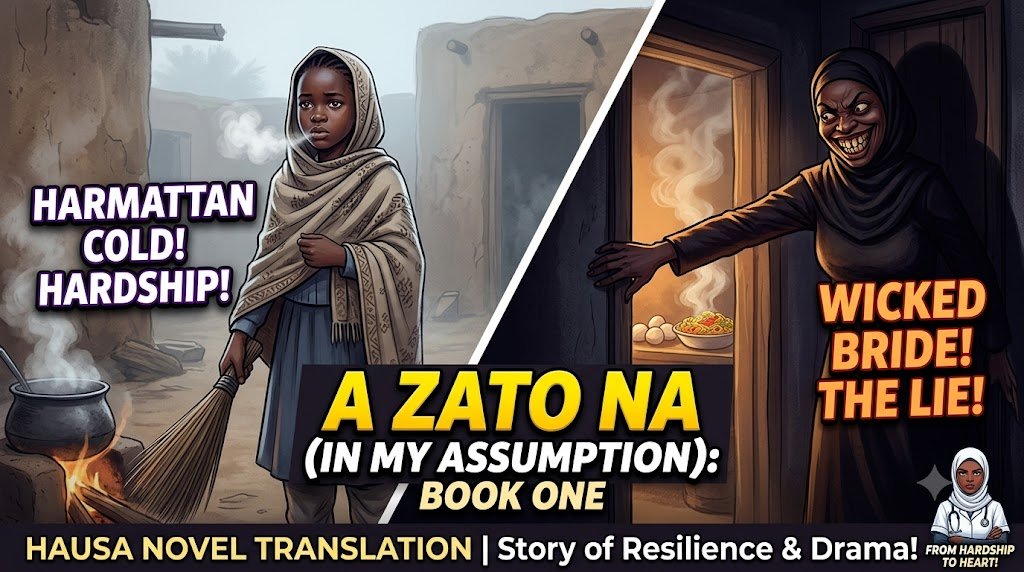
A Zato Na Book 1 Complete Hausa Novel
The next morning, I woke up early, following the usual routine of our household. I swept the courtyard spotlessly clean and lit the hearth fire to boil bath water, as the cold harmattan weather was beginning to set in. After taking my bath, I returned to the room and got dressed.
I sat quietly waiting for someone to come out so we could start cooking breakfast, but there was no sign of movement from anyone. Seeing that it was nearly eight o’clock, I grabbed my Islamic school (Islamiya) bag to head out. I used the key to lock my mother’s room before offering a polite greeting at my father’s door.
It took quite a while before my greeting was answered. I gently pushed open the door and stepped inside. Baba was sitting on the edge of his mattress, while his new bride, Ramata, sat on the floor right beside him—so close that her thigh brushed against his. I quickly lowered my gaze.
In front of them was a lavish breakfast spread: hot tea, a massive loaf of bread, fried eggs, and Indomie instant noodles.
I greeted him calmly, and he responded curtly. Noticing that I hadn’t greeted his new wife, he sternly ordered me to do so. With a boiling heart, I greeted her. She responded with a wide grin, flashing long, crooked teeth in a forced attempt at a smile. In truth, even a dog could tell that smile was fake and manufactured under pressure.
Afterward, I stood there watching them eat peacefully until Baba grew tired of seeing me stand there. He asked what I wanted. I spoke up directly and told him I hadn’t eaten breakfast.
He sliced off a piece of bread, poured a rich cup of tea, and reached out to cut a portion of the egg. But the new bride quickly put her hand out to stay his arm. Tilting her head, she whispered something to him in a low voice. I didn’t catch what she said, but I saw him withdraw his hand and hand me just the plain bread and tea. I accepted them with both hands.
I stepped outside, sat down, and finished it all before washing the cup clean. That was one of the strict habits I had learned from my mother—she never allowed dirty dishes to sit around. Even if she used a single spoon, she would wash it immediately.
Without looking back at Baba or his new bride, I left for school.
At that time, our morning Islamiya session finished at eleven o’clock. From there, I would usually head straight to the home of my maternal grandparents—Mama’s parents. My grandfather, Malam Bako, was a renowned Islamic scholar (malamin allo) widely respected within and outside Gashua town. He had scores of young and adult students from all across Yobe State.
Every day after school, I visited him so he could help review my recitations and assign new lessons. Sometimes I stayed there until it was time for the evening Islamiya session, heading back to school directly from his house without returning home first.
On that particular day, I went there as usual. After our lessons, I overheard that Grandfather had gone to speak with my father regarding his dispute with Mama. My father had stubbornly insisted that he never drove Mama away, claiming she chose to leave on her own accord. It was then I realized that taking a new wife could truly alter a person’s character. I had never heard my father lie until that moment.
Later that evening, Mama returned home. But from the very day Ramata’s feet stepped across the threshold of our compound, we never again experienced the peace and happiness we enjoyed before her arrival…
The sharp sound of the alarm I set pulled me out of a deep slumber. The night before, I had fallen asleep without removing my headphones; I didn’t even remember taking them off, but I spotted them lying on the floor beside my bed. Reaching under my pillow, I pulled out my phone, my vision blurry with sleep. The screen read 4:30 AM.
I often forgot to turn off my Fajr prayer alarm whenever I was observing my monthly routine (fashin sallah). Silencing the alarm, I turned over and went back to sleep.
At six o’clock, my second alarm rang. I managed to drag myself out of bed, staggering slightly. Within an hour, I took a shower and prepared breakfast—well, if you can call Indomie noodles and plain black tea breakfast. By then, my roommate Aylah had also woken up.
I didn’t waste time on elaborate makeup—just lotion, face powder, and lip gloss. Only on rare occasions did I ever bother applying eyeliner or kohl.
Pulling a small stool next to my bed, I ate breakfast. As soon as I finished, I grabbed my crisp white uniform. It consisted of long white trousers and a knee-length white tunic. I tied back my long, thick black hair with a ribbon, wrapped a white scarf over my head, and slipped on a short white hijab that rested neatly across my chest.
Checking my light brown wristwatch, I saw it was nearly 7:30 AM. Hastily wrapping a wide shawl over my shoulders, I grabbed my purse, phone, and clinical notebook—where I recorded all my medical knowledge and daily observations—slipped on my black Toms shoes, shouted a quick goodbye to my roommate, and hurried out the door.
Just as I arrived at the bus stop, the campus shuttle bound for Kongo was pulling up. I joined the queue, paid the fare, and boarded.
A few minutes past eight, I dropped off at my usual stop. From there, I took a commercial motorcycle (acaba) into Gyallesu neighborhood, heading to a small public health centre where I was doing my Teaching Practice (TP). Our shift ran from 8:00 AM to around 1:00 or 2:00 PM. Everyone knows how students love arriving late—especially for practicals where no strict lecturer is locking the door or checking attendance.
Despite my own slight delay, I still arrived before Janan. When it came to being late, Janan was in a league of her own—she never took second place to anyone!
By 11:30 AM, our shift ended. Janan and I walked out of the facility feeling exhausted and somber. There was hardly a day spent at that health center without witnessing something distressing.
That morning, a pregnant woman had been brought in. Three days earlier, a scan had revealed that the fetus had passed away in her womb. Instead of inducing labor, her husband had picked her up and taken her back home. What made it even more infuriating was that her husband worked in the health line—not a certified doctor, but the owner of a large patent medicine chemist shop who thought he knew better.
She had been in labor since two days prior, yet he refused to bring her to the hospital, relying instead on a traditional birth attendant. After endless complications, they finally rushed her to the health center this morning. But as plans were being made to refer her urgently to Shika Hospital for emergency surgery, she passed away.
It was a heartbreaking, tragic situation—leaving behind several very young children who were far too small to understand what had happened.
As Janan and I walked toward the acaba stand, that tragic incident was all we could talk about. Janan turned to me, her voice taking on a pleading tone. “Please, sis, come over to my house first! You can head back home later in the evening, okay?”
I rolled my eyes at her. “Nonsense! May Allah forbid it. Look at me heading straight home!” I quickly signaled one of the waiting motorcycle drivers.
She grabbed my arm urgently. “Please, listen to me! Wallahi, the atmosphere at home has been terrible these past two days. Normally, I get some relief when Yaya Bilal is around, but even he has been so moody since yesterday afternoon. He won’t even look at me! When I greeted him this morning, he didn’t even answer, and he forbade me from going anywhere. Please, come keep me company for a bit!”
A wave of pity washed over me. Janan endured a bizarre, toxic living situation with her brother’s wife. At times, you would mistake it for a bitter co-wife rivalry full of intense jealousy and petty drama.
Without overthinking it further, I nodded. She jumped with joy and gave me a tight hug.
Apologizing to the motorcycle rider, we flagged down a tricyclist (Napep) instead and set off for PZ neighborhood, which wasn’t far from our TP posting site.
Yaya Bilal’s house, where Janan lived, was a massive compound. From a distance, you would think it was a family ancestral home. However, only two people lived there—Bilal and his younger brother, Jameel, along with their respective wives.
Each wife had her own separate, spacious apartment set far apart from the other, such that if one chose to, she could go months without laying eyes on her sister-in-law.
Yaya Bilal’s section was the first apartment upon entering the gate. His section was divided into three sub-units, though two remained locked. Janan lived in the active section alongside Yaya Bilal and his wife, Raheema.
They had been married for nearly two years, yet Allah had not blessed them with children. Whispers circulated around that Yaya Bilal might be infertile—especially since his first wife, Ameerah, whom he had married out of young love and stayed with for six years, had also never conceived.
We quietly stepped into the living room, greeted by total silence. There was no sound of a TV, let alone human voices. Janan led me into her bedroom, then went to the kitchen to fetch us cold water and juice.
As I sat on the edge of her bed, I began to hear loud music thumping from somewhere in the house. I looked at Janan as she stood in front of her wardrobe searching for comfortable clothes for us to wear.
“Where is that loud music coming from?” I asked.
She glanced back briefly before rummaging through her closet again. “No doubt Haleemo and the rest are watching TV.”
I placed a hand over my mouth in disbelief. “Wait, those girls are still staying here?”
She let out a bitter, dry laugh. “Where else would they go? They’re settled here in this house with no intention of leaving!”
She handed me a long skirt and top made of light fabric. Accepting them, I started unbuttoning my uniform. “May Allah continue to protect us!” I muttered.
“Ameen,” she replied softly.
In all my life observing married households and family drama, I had never seen a situation as absurd as the one in Yaya Bilal’s house.
Normally, when a man gets married, he brings his new bride to live in his home. But Raheema’s case was completely different. When she was brought in as a bride, her two younger sisters immediately moved in with her, spreading their legs comfortably in the house. Talk about buy one, get two free!
Seven months after the wedding, Raheema’s closest female friend got divorced. Instead of returning to her family, she also moved straight into Yaya Bilal’s house like someone without a home of her own. Now all three of them were living comfortably under Yaya Bilal’s roof and expense. Yet the house could not accommodate or care for his own single younger sister, Janan.
Every day, their sole mission was plotting ways to drive Janan out of the house—using marabouts, dark charms, scheme after scheme. Only Allah’s divine protection kept her safe in that house.
After finishing her Dhuhr prayer, Janan pulled me toward the kitchen to prepare something for us to eat. While we were cooking, Yaya Bilal stepped into the kitchen, answering our greetings half-heartedly with a sour face.
Glaring at Janan, he asked curtly, “Where is Raheema?”
In a soft, almost fearful tone, Janan replied, “We just got back ourselves, Yaya. We didn’t meet her at home.”
Without another word, he turned and left the kitchen. Whatever was going on, it was unusual. I was used to seeing him treat his younger sister with love and care, but today his demeanor was completely hostile.
I looked at Janan, who was desperately trying to swallow back tears of hurt. My heart broke for her. Allah had made her far too soft-spoken and gentle-hearted.
We mixed a small batch of Danwake (flour dumplings)—just enough to feed the two of us. Despite Janan’s attempts to make a larger portion, I firmly refused. I knew she wanted extra for those lazy, entitlement-minded girls. As far as I was concerned, I would rather go hungry than spend my energy cooking for grown, lazy freeloaders who would eat, wipe their hands on tissues, stretch out their legs, and leave me to clean up their dirty plates.
Once we finished, we transferred the food into a thermal flask and cleaned the kitchen spotlessly, leaving no trace behind. Janan carried the food flask to the bedroom while I picked up the plates and chopped vegetables.
Right at the kitchen doorway, we bumped into Salama, Anty Raheema’s younger sister. Out of all the sisters, Salama was by far the most ill-mannered and disrespectful. That was precisely why our blood never mixed—not even for a second.
She stood there arrogantly, hands on her hips, blocking the narrow hallway completely. Did she actually expect me to step aside and squeeze past her? A wicked smile touched my lips. Girl, you clearly don’t know who I am yet.
I walked straight toward her without slowing down. Realizing I was fully prepared to shoulder-charge right through her, she quickly scrambled backward. I let out a low, subtle sneer in my mind: I wish you had stayed right there so you could see how disrespect gets handled!
She raised her voice aggressively. “Where is our food?!”
I stopped dead in my tracks, turned around, and looked her up and down. “Your food? Did you hire me as your personal cook without my knowledge?”
She sneered, “How dare you come into my sister’s house, cook food, and refuse to leave any for us?”
A burst of sarcastic laughter almost escaped me. “Well, pardon me, Your Majesty! Her Royal Highness!! May Allah grant patience to those of us who don’t have married sisters whose homes we can overstep into and declare a kingdom where we don’t belong! It’s food, and we didn’t cook it for you. If you have any self-respect, the kitchen is right there—go inside and cook something better than what we made!”
I turned on my heel, stepped into the bedroom, and slammed the door shut behind me, hearing her loud rants and insults echoing down the hall.
Janan sighed nervously. “Honestly, you shouldn’t have engaged her!”
I gave her a sharp look. “It’s because you let them walk all over you like a fool that they act like this! You can endure their disrespect if you want, but as for me, wallahi, I will never tolerate their insolence!”
Janan simply nodded silently, knowing that arguing with me was a waste of breath.