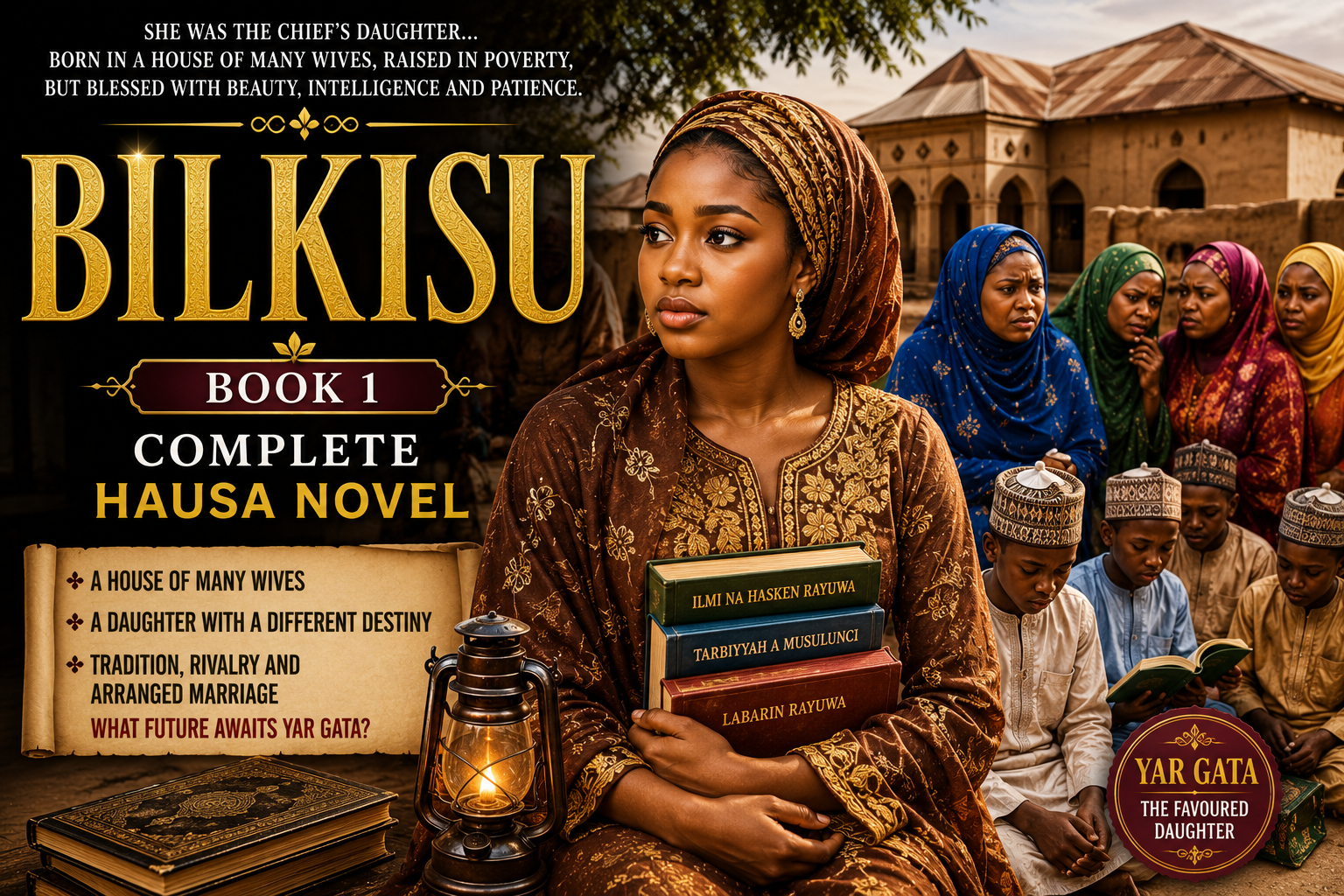
Bilkisu Book 1 Complete Hausa Novel
Bilkisu Book 1 Complete Hausa Novel tells the emotional story of a village chief’s daughter who grows up surrounded by poverty, family rivalry, polygamy, arranged marriages and strict traditions.
Although Bilkisu belongs to a respected family, her childhood is filled with hardship. Her calm nature, intelligence and love for education make her different from many of the other girls in the large household.
Benazir Introduces Bilkisu’s Story
As many of you already know, my name is Benazir. I am a traveller who moves from one place to another, gathering stories and valuable lessons from people’s everyday lives.
I previously brought you the stories of Afrah, Indo and Aliya. I was still considering travelling to meet Gunwa when Aliya suddenly gave me another idea.
She advised me to visit Bilkisu, the young woman famously known as the heiress of the golden bed.
That was exactly what I did.
I deliberately travelled from Bauchi to Gombe so that I could meet Bilkisu and hear her life story from the very beginning.
However, it was not easy to convince her to share her experiences with me.
She finally agreed after I explained that my classmates and I wanted to learn important lessons from her life, because every human being’s journey contains something others can learn from.
Now, here is Bilkisu. She will tell us her story herself.
Dear readers, follow closely and listen carefully.
Bilkisu Begins Her Life Story
My name is Bilkisu Sa’ad.
My father was the traditional ruler of our village, but despite his respected position, I grew up surrounded by poverty and hardship.
My father had thirty-six children from four wives.
His wives were Rahama, Siddiqa, Suwaiba and my mother, Aisha.
My mother had eight children. Rahama, the first wife, had ten children, and all of them were girls. Siddiqa had nine children, while Suwaiba had eight.
Life Inside a Large Polygamous Family
Our family compound was extremely large, but it was equally filled with serious problems and constant conflict.
Anyone who knew how to defend themselves had to do so, because false accusations, manipulation and secret plots were common inside the household.
My mother was a patient, peaceful and reserved woman.
Unfortunately, her gentle nature made her the person who suffered most in the hands of the other women in the family.
My mother had two daughters and six sons.
My younger sister and I were the only girls among her eight children.
Children Were Expected to Work on the Farm
My father was a hardworking farmer who owned and cultivated large areas of farmland.
Because of this, every child in the family was expected to begin working on the farm as soon as they became old enough.
My father did not believe in Western education.
He refused to send his children to conventional schools because he believed that farming and Islamic education were enough for them.
For the girls, the rule was very simple: once a girl completed her Islamic education and reached the age of fifteen, my father would arrange her marriage.
Marriage Was Restricted to Family Members
Only marriages between relatives were accepted in our family.
From the time I was born, I had never seen any girl from our household marry a man who was not related to us.
Whether a girl liked the arrangement or not, she would be married to one of our paternal uncle’s sons.
Our uncle also had a very large family, with approximately forty-six children.
This meant that there were always enough male relatives available whenever one of the girls in our household reached marriageable age.
Bilkisu at Fourteen Years Old
I grew up under these conditions, and at the time this part of my story began, I was fourteen years old.
I attended an Islamic school, commonly known as Islamiyya.
It was a tradition in our family for the younger children to gather outside every evening and spend time talking together.
Some of my stepmothers’ daughters were close to my age.
Among them were Khadija, Aisha and Maryam.
Although we were born to different mothers and slept in separate rooms, we lived together in the same large family compound.
Bilkisu Was Different From the Other Girls
Among the girls, I considered myself the calmest, most organised and most committed to learning.
I was also fortunate to have been blessed with beauty and a naturally attractive appearance.
Khadija and Maryam, however, were extremely playful, talkative and filled with unrealistic ambitions.
They disliked attending Islamic school and preferred spending their time accepting money and gifts from young men.
They behaved confidently because our father’s family was highly respected throughout the village.
Bilkisu’s Love for Books and Knowledge
Whenever the other girls became involved in behaviour I disliked, I would collect my books and return to my mother.
I often asked her to provide me with more books to read.
She would also tell me meaningful stories and teach me lessons that she believed would help me later in life.
My mother was the kind of parent who paid close attention to her children and carefully observed their behaviour.
For that reason, she never treated matters concerning our upbringing carelessly.
Bilkisu and Her Younger Sister Fatima
My younger sister’s name was Fatima, although we usually called her Hajja Teema.
She was named after our grandmother, the mother of the village chief.
As for me, God had created me with a striking resemblance to that same grandmother.
She loved me more than all her other grandchildren because of how much I looked like her.
She always called me “the favoured daughter.”
Eventually, almost everyone stopped calling me Bilkisu.
Instead, I became widely known as Yar Gata—the Favoured Daughter.
Read Bilkisu Book 1 Complete Hausa Novel
The opening chapter of Bilkisu Book 1 Complete Hausa Novel introduces readers to a respected but troubled polygamous household controlled by strict traditions.
Bilkisu grows up as the daughter of a village chief, yet her family’s social status does not protect her from poverty, jealousy, rivalry and the pressure of an arranged marriage.
Her love for knowledge and her mother’s careful guidance may help her survive the challenges ahead, but the family tradition demands that she marry one of her relatives when she turns fifteen.
Continue reading to discover whether Bilkisu will accept the future chosen for her, how her relationship with the other girls will develop, and why her grandmother’s special affection may change her destiny.
Explore more complete Hausa novels, family dramas, village stories and English translations on this website.